
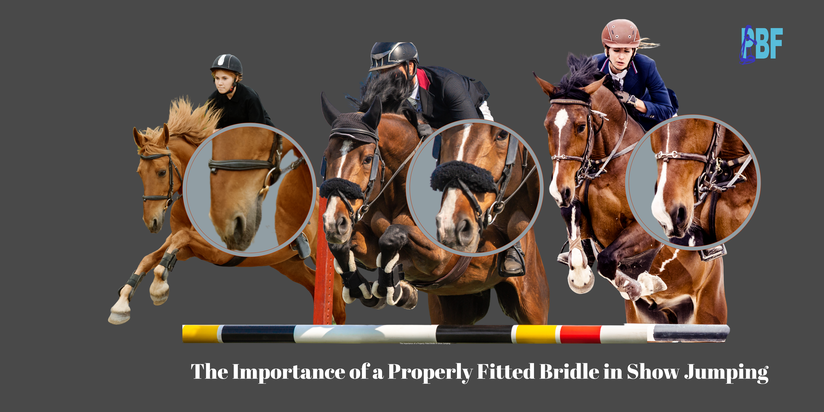
Show jumpers are often willing to use different bits to support their horse as effectively as possible. Riders look for refinement, control, and clear communication. But how critically do we actually evaluate the bridle itself? And what influence might it have on jumping performance?
A bridle sits on and around vulnerable structures: the temporomandibular joint (TMJ), important nerve pathways, blood vessels, muscle attachments, and fascial lines that continue through the neck and even toward the hind limbs. The head is not an isolated structure; it is the beginning of a chain that influences the entire body.
In a discipline where forces and accelerations are high, it is essential that a bridle is supportive and certainly not restrictive. During takeoff and landing, enormous forces are absorbed. The horse stabilizes through the neck, jaw, and hyoid apparatus to maintain balance. This stabilization occurs within the framework of the bridle.
A show jumping horse therefore benefits at least as much—possibly even more—from a well-fitting bridle as a dressage horse. Jumping, and even just approaching and negotiating a fence, involves rapid changes in position, abrupt loading moments, and dynamic redistribution of tension. Whereas dressage involves more continuous and controlled loading, jumping requires fractions of a second of stabilization and adjustment.
In general, riders allow the necessary rein release over a fence so as not to interfere with the horse. This means they soften or lengthen the reins slightly, reducing pressure on the bit and bridle while the horse is in the air. But that is only one phase of the jump. At takeoff—and especially on landing—something very different happens. In a fraction of a second, the horse must absorb the impact with its entire body and restore balance. The neck moves, the head changes position, and the lower jaw contributes to overall stability. At that moment, the horse comes more “into” the bridle, and correct fit becomes crucial. If, during landing, a component of the bridle presses or cuts into a sensitive area, the horse may already begin to hold back in the jump.
How does a horse stabilize itself? You can compare it to how we sometimes clench our teeth when exerting force or reacting to a shock. That action provides stability. The jaws play an important role in this process. A horse may fix the lower jaw to maintain control and create stability throughout the body.
If a noseband is tight, or if a buckle or strap presses on an area that is sensitive for that particular horse, the horse will compensate, and stabilization becomes less free. Forces may then shift laterally, or pressure may arise in places where it is not intended. This can lead to effects such as uneven limb loading, trunk rotation, and other biomechanical consequences, which are explored in the PBF Professional Bridlefitting course.
The jump itself does not automatically increase pressure. However, the rapid movements and the absorption of forces mean that the bridle plays a significant role in how the horse is able to stabilize.
And this is precisely what you do not see when the horse is standing still. A PBF bridle fitter, however, can palpate, analyze, and test these aspects together with you as the rider. If you are interested in the course, please email [email protected]
Write a comment